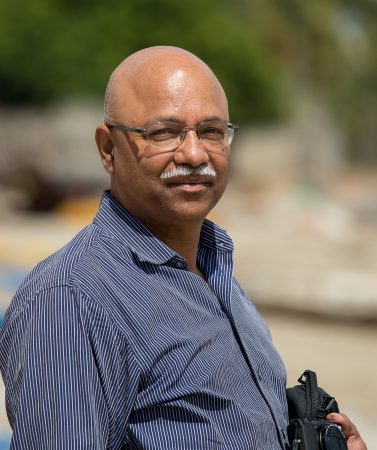
Vinay Kamat
Research Area
Research Stream
Education
Ph.D., Emory University, 2004 | MA, University of Arizona, 1994 | Ph.D., Tata Institute of Social Sciences, 1992
About
I trained as a medical anthropologist with specialization in global health, first at the University of Arizona, Tucson, and then at Emory University, Atlanta, from where I received my Ph.D. in Anthropology. Before that, I trained as a professional social worker and received my Ph.D. in Social Work from the Tata Institute of Social Sciences, Bombay, India. Since 2003, I have held the Keith Burwell Professorship in Medical Anthropology at UBC. Over the last 30 years, I have conducted extensive ethnographic research in India and Tanzania and published my research in numerous peer-reviewed scholarly articles and two books: Silent Violence: Global Health, Malaria, and Child Survival in Tanzania (2013), and In a Wounded Land: Conservation, Extraction, and Human Well-Being in Coastal Tanzania (2024) both published by the University of Arizona Press.
My research interests over the last 30 years have evolved in the context of my theoretical training, teaching, and ethnographic fieldwork. In the Indian context, I have examined the politics of primary health care, the resurgence of urban malaria, and the political economy of the outsourcing of pharmaceutical clinical trials. In the Tanzanian context, I have conducted ethnographic research on the everyday lived experience of marginalized people caught in rapid social transformation engendered through neoliberal economic reforms. I have specifically examined what the privatization of health care has translated into for the marginalized people in coastal Tanzania at a time of mounting financial burdens, uncertainty, and increasing prospects of being afflicted by life-threatening infectious diseases like HIV/AIDS, tuberculosis, and malaria. I have partnered with local NGOs and academic institutions to conduct ethnographic research with an applied component, including a two-year SSHRC-funded project on COVID-19. My new book In a Wounded Land is an anthropological exploration of the human dimension of marine conservation in Tanzania. Based on fieldwork conducted over ten years in southeastern Tanzania, in this book, I show what happens when impoverished people living in underdeveloped regions of Africa are suddenly subjected to top-down, state-directed conservation and natural resource extraction projects implemented in their landscapes of subsistence. Through rich case studies and vignettes, I show how state power, processes of displacement and dispossession, forms of local resistance and acquiescence, environmental and social justice, and human well-being become interconnected in the context of marine conservation and a natural gas extraction project. The book reveals the social implications of the copresence of a marine park and a gas project at a time when rural populations in several African countries are experiencing rapid social transformation brought about by internationally funded conservation initiatives and extractive projects.
I am currently studying the impact of climate change and extreme weather events on artisanal fishing communities in Rural Mtwara and Kilwa (Kilwa Kivinje, a UNESCO-designated historical archeological site, and Kilwa Masoko) in Tanzania. My research is funded by a SSHRC Partnership Engage Grant (2024-2025) and a SSHRC Insight Grant (2025-2030).
In addition to teaching, conducting research, and writing, I have served as chair of the African Studies Minor Program at UBC (2012-2015). For more information please visit: https://africanstudies.arts.ubc.ca/
Teaching
Research
Medical anthropology; ethnography; global health; India: clinical drug trials; Tanzania: childhood malaria; East Africa: ecological risk, climate change adaptation, marine conservation; dispossession; extractive industry; political ecology
Publications
Books
Kamat, Vinay. 2024. In a Wounded Land: Conservation, Extraction, and Human Well-Being in Coastal Tanzania. University of Arizona Press, Tucson, 351 pages. https://open.uapress.arizona.edu/projects/in-a-wounded-land
Kamat, Vinay. 2013. Silent Violence: Global Health, Malaria, and Child Survival in Tanzania, University of Arizona Press, Tucson, 321 pages. https://open.uapress.arizona.edu/projects/silent-violence
Journals/Articles (Peer Reviewed)
Singleton, R., Edward Allison, Charlotte Gough, Vinay Kamat, Philippe Le Billon, Laura Robson, and U. Rashid Sumaila. 2019. Conservation, contraception, and controversy: Supporting human rights to enable sustainable fisheries in Madagascar. Global Environmental Change 59: November 101946. https://doi.org/10.1016/j.gloenvcha.2019.101946
Kamat, Vinay, Philippe Le Billon, Rosemarie Mwaipopo, and Justin Raycraft. 2019. Natural gas extraction and community development in Tanzania: Documenting the gaps between rhetoric and reality. The Extractive Industries and Society 6:968-976. https://doi.org/10.1016/j.exis.2019.03.011[Kamat 80%]
Kamat, Vinay. 2019. Dynamite fishing in southeastern Tanzania: Why youth perceptions matter. Coastal Management 47(4):387-405. https://doi.org/10.1080/08920753.2019.1619902
Kamat, Vinay and Mai-Lei Woo Kinshella. 2018. Food insecurity and coping strategies in a marine protected area in Southeastern Tanzania. Ecology of Food and Nutrition 57(3):187-205. https://doi.org/10.1080/03670244.2018.1455672 [Kamat 80%]
Kamat Vinay. 2018. Dispossession and disenchantment: The micropolitics of marine conservation in southeastern Tanzania. Marine Policy 88:261-268. https://doi.org/10.1016/j.marpol.2017.12.002
Kamat, Vinay. 2017. Powering the nation: Gas development and distributive justice in Tanzania. Human Organization. 76(4):304-314. https://www.jstor.org/stable/26586854
Kamat, Vinay. 2014. “The ocean is our farm!” Marine conservation, food insecurity, and social suffering in southeastern Tanzania. Human Organization 73(3):289-298. https://doi.org/10.17730/humo.73.3.f43k115544761g0v
Kamat, Vinay. 2014. Fast, cheap, and out of control? Speculations and ethical concerns in the outsourcing of clinical trials in India. Social Science and Medicine 140 (February), 48-55. https://doi.org/10.1016/j.socscimed.2013.12.008
Kamat, Vinay. 2012. “Invited commentary on Claire Wendland’s book: Animating biomedicine’s moral order: The crisis of practice in Malawian medical training. Current Anthropology 53(6), 755-788. https://www.journals.uchicago.edu/doi/10.1086/668467
Kamat, Vinay and Daniel Nyato. 2010. Soft targets or partners in health? Retail pharmacies and their role in Tanzania’s malaria control program. Social Science and Medicine 71(3):626-633. https://doi.org/10.1016/j.socscimed.2010.04.016 [Kamat 80%].
Kamat, Vinay and Daniel Nyato. 2010. Community response to artemisinin-based combination therapy for childhood malaria: A case study from Dar es Salaam, Tanzania. Malaria Journal 9:61. https://doi.org/10.1186/1475-2875-9-61 [Kamat 80%].
Kamat, Vinay. 2009. Cultural interpretations of the efficacy and side effects of antimalarials in Tanzania. Anthropology and Medicine 16(3):293-305. https://doi.org/10.1080/13648470903246854
Kamat, Vinay. 2008. This is not our culture! Discourse of nostalgia and narratives of health concerns in post-socialist Tanzania. Africa 73(3):359-383. https://doi.org/10.3366/E0001972008000223
Kamat, Vinay. 2008. Reconsidering the allure of the culturally distant in therapy seeking: A case study from coastal Tanzania. Medical Anthropology 27(2):106-135. https://doi.org/10.1080/01459740802017314
Kamat, Vinay. 2008. Dying under the bird’s shadow: Representations of degedege and child survival among the Zaramo of Tanzania. Medical Anthropology Quarterly 22(1):67-93. https://doi.org/10.1111/j.1548-1387.2008.00004.x
Kamat, Vinay. 2006. “I thought it was only ordinary fever!” Cultural knowledge and the micropolitics of childhood febrile illness in Tanzania. Social Science and Medicine. 62(12):2945-2959. https://doi.org/10.1016/j.socscimed.2005.11.042
Kamat, Vinay. 2001. Private practitioners and their role in the resurgence of malaria in Mumbai (Bombay) and Navi Mumbai (New Bombay): serving the affected or aiding an epidemic? Social Science and Medicine 52:885-909. https://doi.org/10.1016/S0277-9536(00)00191-X
Kamat, Vinay. 2000. Resurgence of malaria in Bombay (Mumbai) in the 1990s: a historical perspective. Parassitologia. 42:135-148.
Kamat, Vinay and Mark Nichter. 1998. Pharmacies, self-medication, and pharmaceutical marketing in Bombay, India. Social Science and Medicine. 47:779-794. https://doi.org/10.1016/S0277-9536(98)00134-8 (Kamat 80%)
Kamat, Vinay. 1995. Reconsidering the popularity of primary health centers in India: a case study from rural Maharashtra, India. Social Science and Medicine 41(1):87-98. https://doi.org/10.1016/0277-9536(94)00309-H
Book Chapters
Kamat, Vinay. 2018. “And what will our children eat?” Dispossession and food security concerns among Muslim Makonde men on Tanzania’s Swahili coast. Reconceiving Muslim Men: Love and Marriage, Family and Care in Precarious Times Edited by Marcia Inhorn and Nafissa Naguib. Chapter 12, Pp. 245-261. Berghahn Books, New York and Oxford. https://www.berghahnbooks.com/title/InhornMuslim
Kamat, Vinay. 2009. Anthropology of childhood malaria in Tanzania. (First Chapter) In. Robert Hahn and Marcia Inhorn (eds) 2nd edition. Anthropology in Public Health. Bridging Differences in Culture and Society. Pp. 3-32. New York: Oxford University Press, USA. https://academic.oup.com/book/32864
Kamat, Vinay and Mark Nichter. 1997. Monitoring product movement: an ethnographic study of pharmaceutical sales representatives in Bombay, India. In. Sara Bennett, Barbara McPhake and Anne Mills (eds). Private Health Providers in Developing Countries: Serving the Public Interest? Pp.121-140. London: Zed Press. [Kamat 75%] https://www.bloomsbury.com/us/private-health-providers-in-developing-countries-9781856494960/
Awards
TEACHING AWARDS
Best Undergraduate Teaching Award for 2010-2011. Anthropology Students Association (January 09, 2011)
Best Undergraduate Teaching Award for 2009-2010. Anthropology Students Association (May 27, 2010)
Outstanding Teaching Award 2004-2005: Anthropology & Sociology Undergraduate Society (March 29, 2005)
AWARDS FOR SCHOLARSHIP AND RESEARCH
SSHRC Insight Grant “Climate Change, Ecological Risk, and Adaptive Capacity Among Artisanal Fishing Communities in Coastal Tanzania” 2025-2030.
SSHRC Partnership Engage Grant “Mitigating the Impacts of Climate Change on Fisheries-dependent Communities in Coastal Southeastern Tanzania” 2024-2025.
SSHRC Partnership Engage Grant “Where there is no Lockdown: Local Response to the COVID-19 Pandemic in Tanzania” 2021-2022.
Dean of Arts, Faculty Research Award, 2019.
SSHRC Insight Grant “Contested Landscapes: The Social Complexity of Natural Gas Extraction in a Marine Protected Area in Tanzania” 2018-2022.
Canadian International Resources and Development Institute Grant “Natural Gas Projects and Community Development in East Africa” 2015-2016.
Visiting Research Fellow, The Brocher Foundation, Geneva, Switzerland, October and November 2015.
SSHRC Insight Development Grant “Micropolitics of Conservation and Dispossession on a Marine Park in Southeastern Tanzania” 2014-2016.
Wenner Gren Richard Carley Hunt Postdoctoral Fellowship awarded for 12 months starting April 2011.
Martha Piper Fund Grant “Structural Violence, Social Suffering and Everyday Lives of Single Mothers in Tanzania” 2008-2009.
SSHRC, Standard Research Grant “Global Discourses on Malaria Control and their Impact on Local Communities in Tanzania” 2006-2009.
Early Career Scholar: Peter Wall Institute of Advanced Studies, September 2005 to August 2006.
Hampton Research Fund Grant “Fast, Cheap and Out of Control? The Political Economy of the Outsourcing of Clinical Drug Trials to India” 2005-2006
PRIOR TO COMING TO UBC
Wenner Gren Foundation for Anthropological Research 2000-2001
National Science Foundation 1999-2000
Emory University Fund for Internationalization 1999
International Development Research Centre, Canada 1994-1996